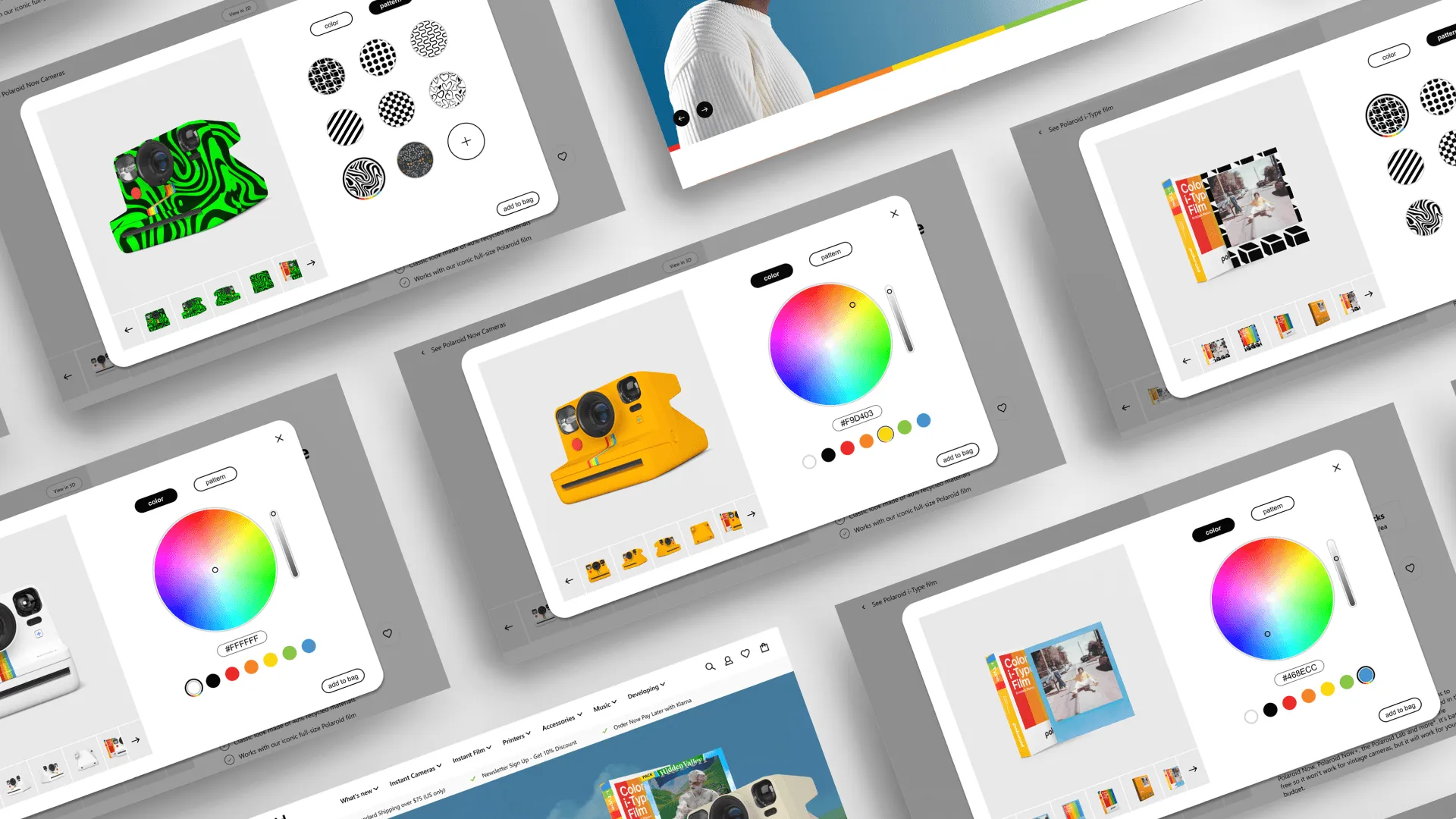
Polaroid's site on angled screens, showing the camera color picker.

Polaroid Customization

Context
Polaroid (school project, unaffiliated)
Role
UX/UI researcher & designer
Timeline
Jan–Feb 2024

Overview

Polaroid is the name brand of instant cameras, yet buyers keep choosing a camera that costs half as much. I designed the color campaign: a camera and film customizer, plus artist partnerships, that let people make their Polaroid uniquely theirs, so the premium price feels worth it.

The Problem

The name brand, priced out of its own market

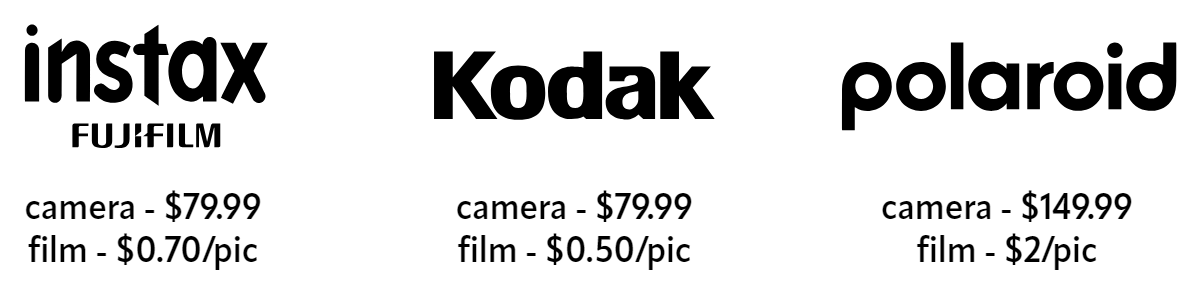
Instax, Kodak and Polaroid instant cameras side by side with their camera and per-picture prices.

The problem I found was that Polaroid is the name brand of its market, yet it isn't competitive in it. The Polaroid Now+ camera cost $149.99, plus $2 a picture. Fujifilm's Instax and Kodak both cost $79.99, at $0.70 and $0.50 a picture (Amazon, 2024). When I searched for the best-selling instant camera, Instax consistently came up. People would rather buy the cheaper camera. I wanted to find a way to change that.

The Process

  1. Brand audit
  2. Creative brief
  3. Wireframes
  4. Roughs and progress report
  5. Final prototype and presentation

Discovery & Research

A colorful brand, a flagship in four colors

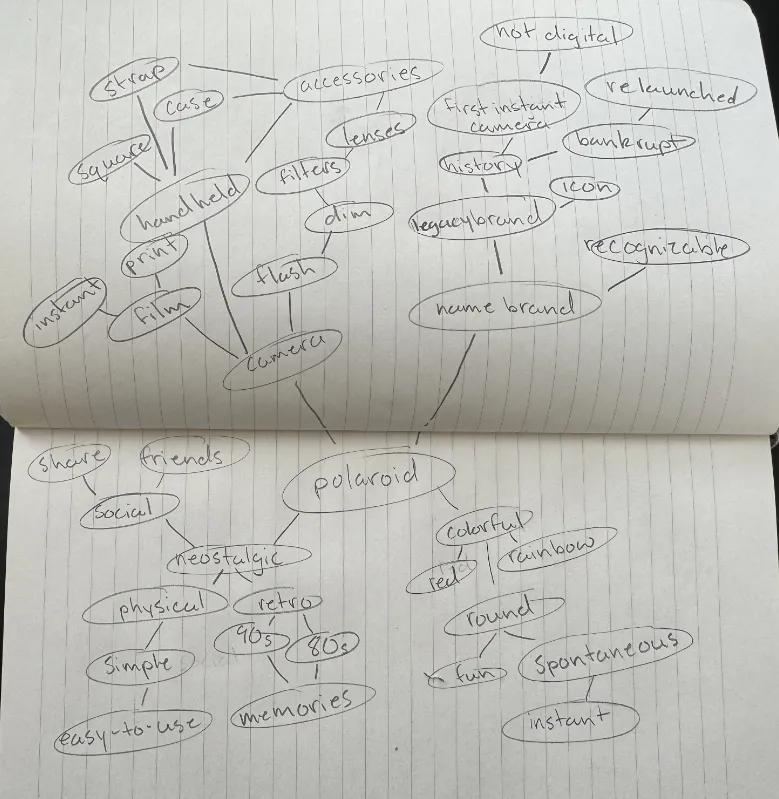
Mind map of how I think of Polaroid.
Mind map of how I think of Polaroid

I started with Polaroid's history and values, then did a mind map for the brand, scanned competitors, and built a persona of that audience. I focused on the Now+, the flagship product.

Two findings shaped everything after:

  • Finding 01

    Instax was cheaper and more personal.

    Beyond the price, there were all these accessories you could also buy.

  • Finding 02

    The brand's colors didn't reach the product.

    Polaroid's branding talks about expressing creativity, with a rainbow stripe and color everywhere, yet the Now+ came in just four colors. It seemed like a disconnect to me.

I studied the Converse shoe customizer. The shoe updates live as you design it, which told me a live camera preview was doable. And Converse charges more for a shoe you make your own, a sign that people will pay more for something custom.

Insights

Make it worth it, not cheaper

How do you make the purchase worth it? By adding personal value: make the camera as unique as the moments it captures.

Polaroid is about capturing moments that are yours. If the camera is yours too, the price is easier to justify. Instax and Converse both pointed the same way, but whether personalization would make someone choose a Polaroid was still an assumption I made with anecdotal evidence to support it.

Ideation & Concept Development

The color campaign

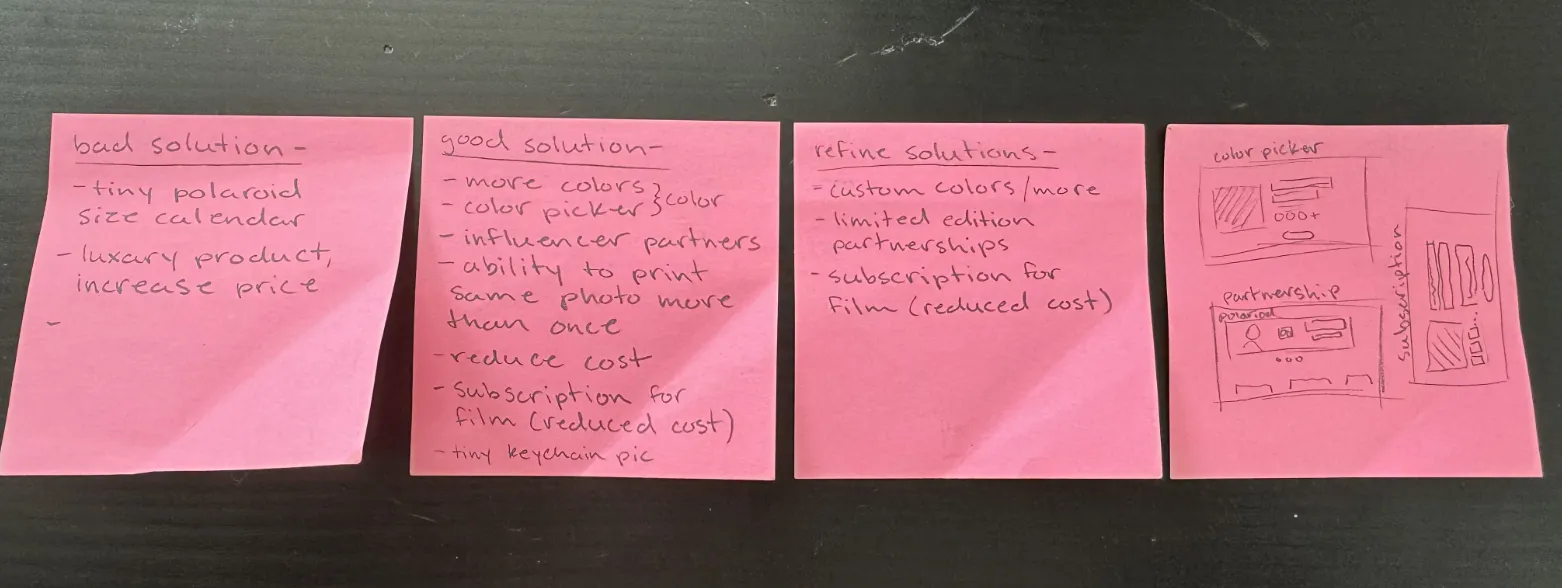
Sticky notes sorting bad, good and refined solutions.
My ideation process. Bad solutions, good solutions, refined solutions.

The question became:

How might I make the premium price feel worth it?

I started with deliberately bad ideas, then good ones, then refined the list.

Reduce the cost
It was on the board, but my goal was to make the premium worth it, not cheaper.
Film subscription
Saving a little on film won't close the gap on the camera, and the camera was the biggest pain point.
Limited-edition accessories
These didn't justify the price either, and with six weeks, I needed to focus.
Custom colors + limited-edition partnerships
Both put more personal cameras into the world. They're "symbiotic" solutions, so I combined them into one idea: the color campaign.

I wrote it up as a creative brief with the hook "capture the color wheel" and one objective: increase the personal value of Polaroid to make the price worth it. It was aimed at photography enthusiasts, millennials and Gen Z, travelers, and people who prefer analog or want to experiment.

Iteration

From a list of colors to colors and patterns

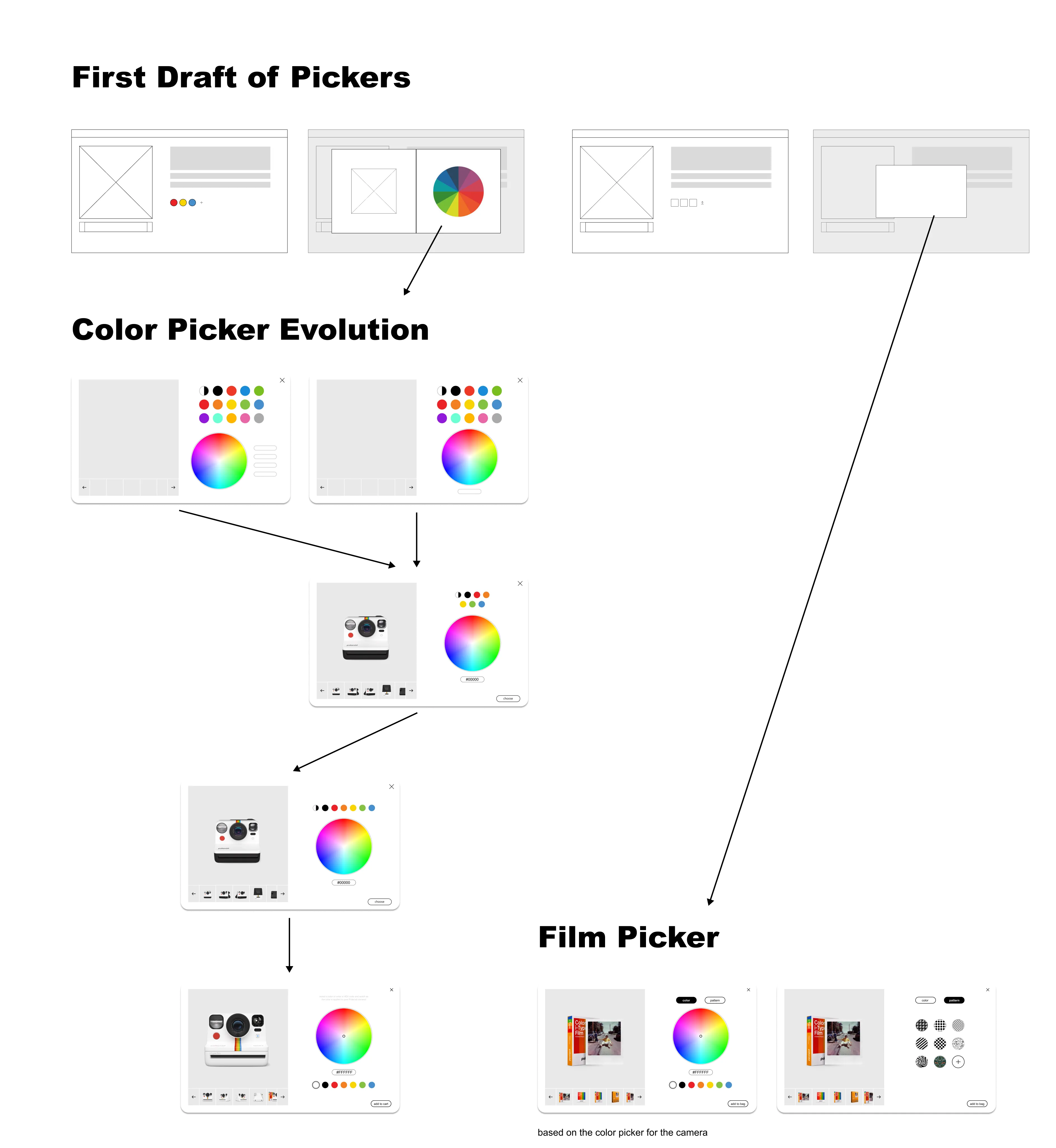
Board showing the color picker's evolution from inline swatches to a wheel with a tone slider and a pattern tab.

I started with wireframes, then moved to designs on Polaroid's real site pages. I also designed a flow chart of the purchasing flow to work out how the color picking would work, and which screens I needed to design and where.

The picker started as inline swatches with a "+" that opened a color wheel. Each round fixed something:

A tone slider
Without it, you couldn't get darker colors with the wheel I was using.
Fewer presets, closer to the button
Once the wheel existed, a long preset list was redundant. The wheel is the key feature, so it took the center. The controls people touch most moved closest to "add to bag."

The turning point came from a friend critiquing my mock-ups. She mentioned that if I was customizing beyond colors, I could add patterns or prints. Before that, it was only colors. I added a pattern tab and reworked the layout around it.

Solution

A customizer for the camera and its film

I delivered:

  • A camera customization flow: product listing → product page → picker (color, pattern, or upload your own)
  • A film customization flow built on the same picker
  • Homepage heroes for artist partnerships
  • A clickable prototype on Polaroid's own site screens, with a live camera preview
  • A flow chart of the user's path, from the homepage to checkout

01. Any color, not a longer list

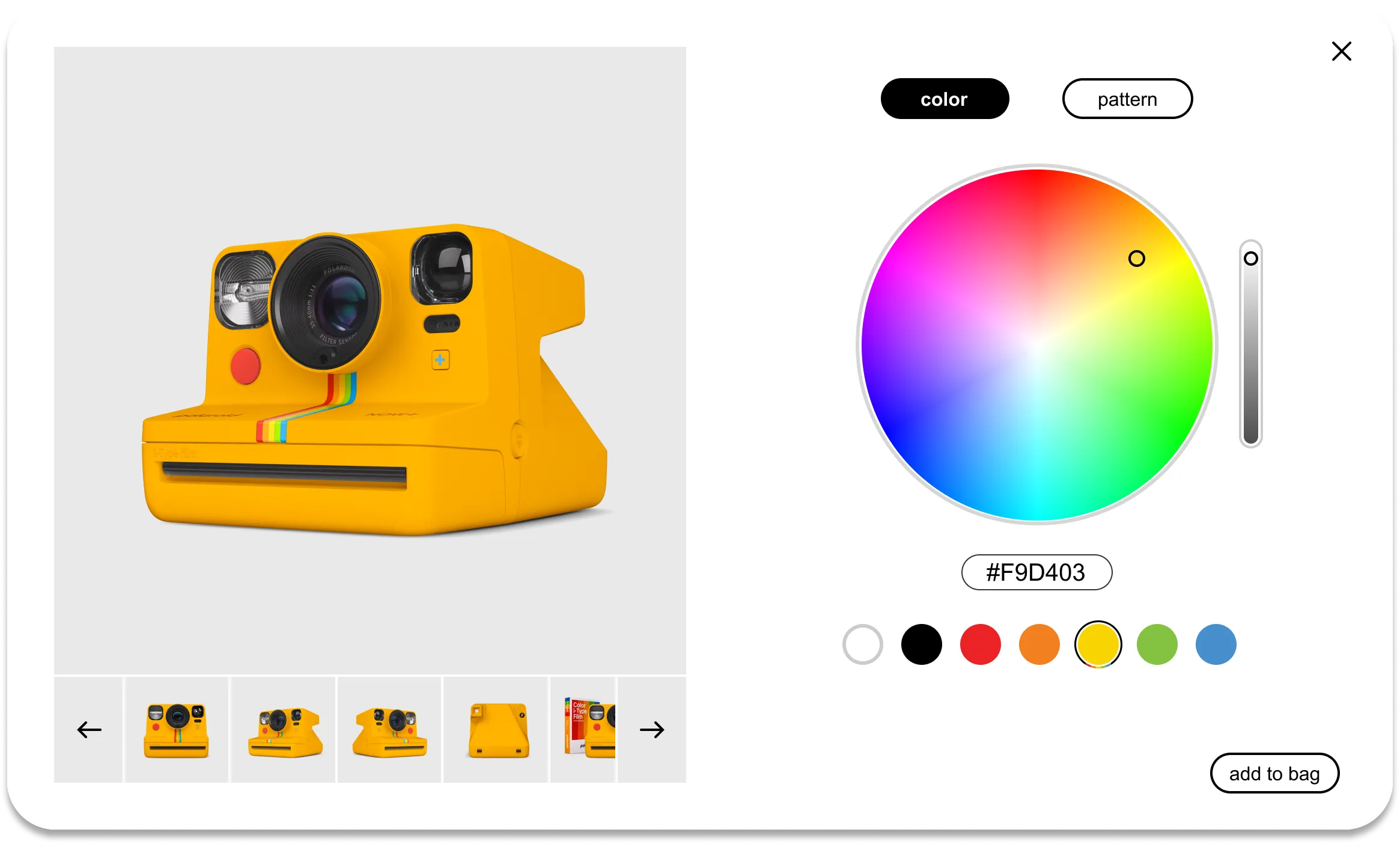
The camera picker showing a yellow Polaroid with color, pattern and upload options.
Any color, plus patterns or your own upload, previewed on the camera.

The only way I could see to justify the cost was to bring meaning to the product beyond the number. To do that for every buyer, you let them make it their own. A bigger preset set caps how unique a camera can be: 10 colors and 10 patterns is only about 100 combinations. An open wheel, preset patterns, and your own uploads make each camera far more unique. The presets that remain are black, white, and a color for each stripe in the logo, which closes the disconnect I found in Discovery. The same picker carries over to film, so the frame of every photo can be yours too.

The cost: an open wheel means any color, and I never worked out whether Polaroid could make and print any color.

02. Partnerships as the other half of the campaign

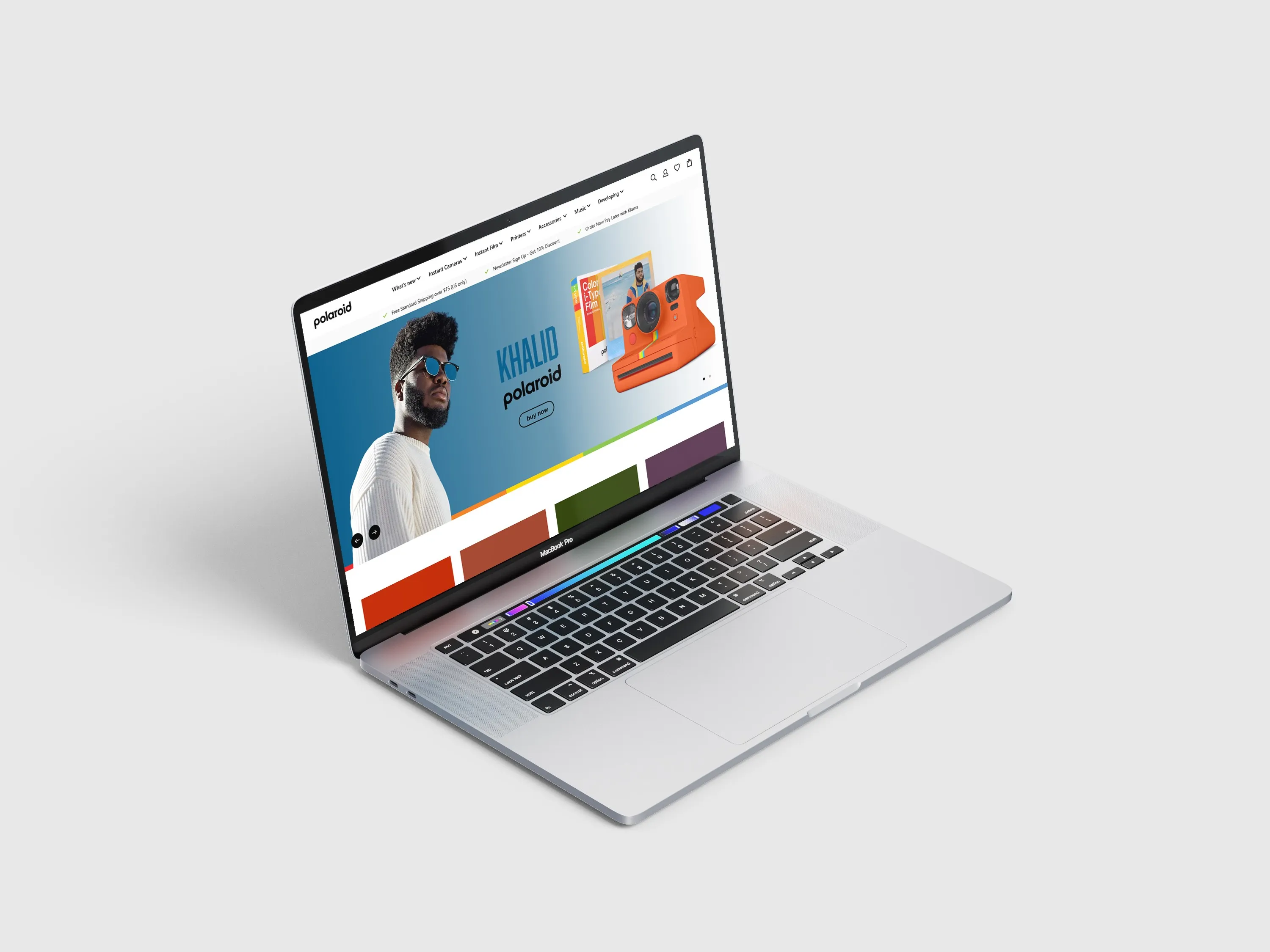
A laptop showing a Polaroid homepage hero for a Khalid partnership camera.
Partnerships bring limited-edition colors and patterns from artists people already care about.

Custom colors are one way for the camera to reflect its owner. Another is through the artists and brands they identify with. If you're a massive Khalid fan, you're likely to buy his merch. If you're not, it's still a fun new camera every so often. So partnerships became limited-edition colors, patterns, and film frames, introduced on the homepage. I designed it only as far as the homepage hero. A collab camera would sell through the same customizer flow, packaged with the partner's colors and patterns.

Impact & Results

Well received in class, untested with buyers

This was a school project, presented in class and never shipped. Classmates said it looked "highly professional and realistic." My instructor thought it was well done and well thought through: the flow worked, and the UI made sense.

What it doesn't prove is the premise. The right question isn't whether Polaroid buyers would pay more. They already do. It's "would this make you more likely to buy a Polaroid?" Even one more percentage point of buyers would be a good start. If Polaroid picked this up, after feasibility, I'd validate whether the picker can reach every tone (is HEX right?) and the selector layout.

Reflection

I never asked how it would be made

  • What went well

    The UI looks really solid. I built it on Polaroid's real site screens and assets, so the picker reads like part of their store.

  • What didn't go as well

    Feasibility. My instructor asked whether I'd considered how these cameras would actually be printed, and I hadn't. I'd never designed for a physical product before, so the real-world logistics were a blind spot.

  • What I'd improve

    Check feasibility first. In digital work, I check with developers before presenting a solution. On a physical product, I'd ask whoever I could, or pass it up the ladder: is this even feasible?

Something to keep in mind for future work is understanding feasibility as soon as possible.